Cities seem to bring the worst out in people, according to many thinkers. Most sociologists of the 19th century found humanity’s fault not in humanity itself but in its surroundings. We don’t grow poisonous but the soil we grow in contains this toxic substance that make us all into these selfish and lonely creatures. But is it really like that? What essence does a city have, if it has any?
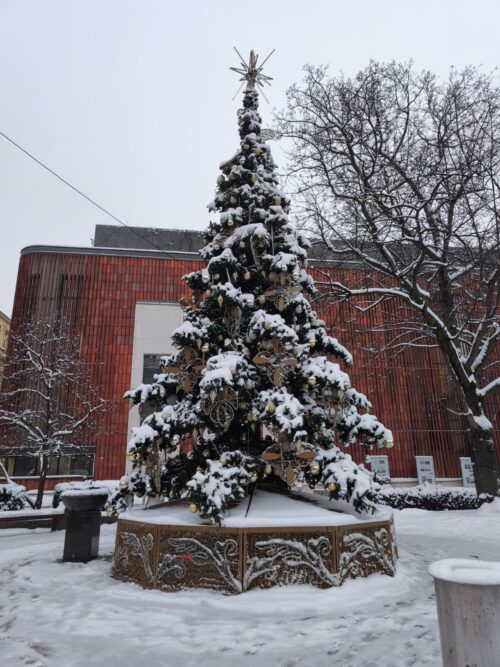
This year, I have lived two different Christmases in two different cities – Krakow and Madrid. Christmas in Krakow seemed to appear more solemn, with its present religious motives and elegant lights that dared not deviate from a quiet gold or silver. On the contrary, Madrid, with its lightning that would cause an epileptic to perish, and overrun with tourists, offers a very different version of Christmas.
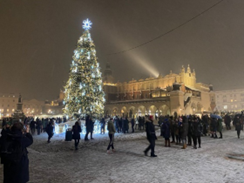
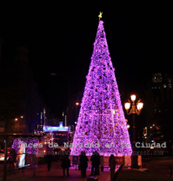
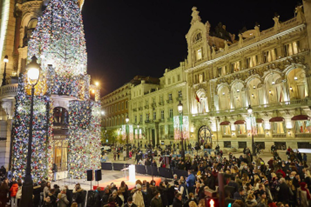
Does a neon pink tree eliminate the Christmas spirit? Or does it just adapt the holidays to the current attention-seeking times? The saying goes, you can’t judge a book by cover. But I think you can, at least when we’re talking about Christmas decorations. I remember, back in 2022, when I went to Milan, I was unpleasantly surprised by how any decoration that was beautiful enough was paid by a private company, a luxurious brand like Gucci or Louis Vuitton, most of us mere mortals can only dream of ever affording.
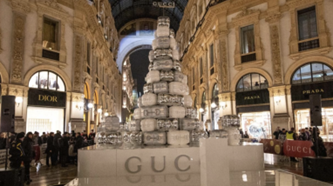
Does it lose its purpose? Transform us even more into mindless consumers and numb the holiday cheer about generosity and empathy? Christmas wouldn’t be Christmas without gifts, after all, no matter how hard we try to give another meaning that deviates from the capitalistic one. Then, why shouldn’t our temporary light pollution be paid by these same companies, protagonists of our holiday wishes? All of these bigger than life decorations with their almost obscene display of wealth turn into almost parodical version of the Christmas criticized by the cynics.
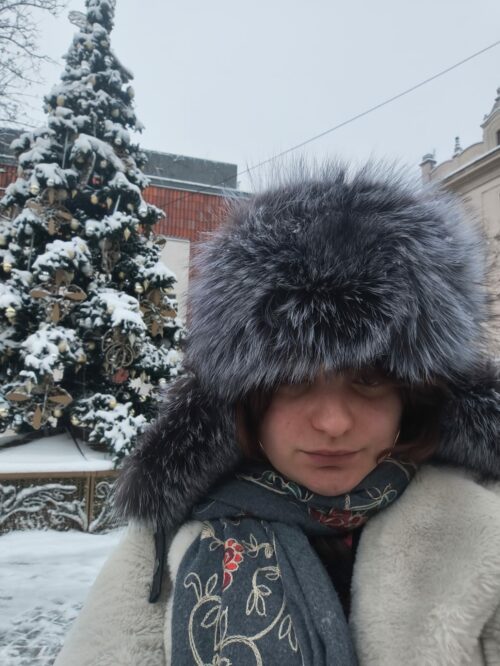
Would Christmas be more Christmas in a village? I doubt so, really. Like Sinatra’s, as well as many others, voice sings; I’ll be home for Christmas (if only in my dreams). Therefore, the Christmas spirit resides at home, wherever your heart is. Then, wouldn’t Christmas be more Christmas in these big soulless capital cities for us who were born there? Then how come the snow in Krakow, be it late November or early January, gives me more of a Christmas spirit than the big lights in my city? Is my city suddenly too big for me? Can that happen?
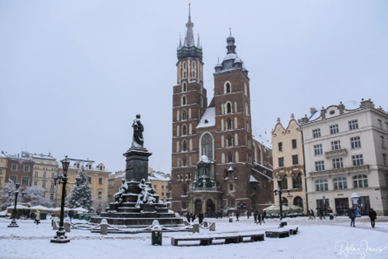
The tiringly quoted philosopher, Nietzsche, had amongst his Best Of Quotes; ‘‘Against that positivism which stops before phenomena, saying „there are only facts,” I should say: no, it is precisely facts that do not exist, only interpretations.’’ Is the old German correct with this? Even the size of a city, quantifiable by its inhabitants or square kilometres, is something up for debate. One thing that greatly surprised me when coming to Krakow is that this city is relaxing, calm, almost a quiet one at being a city. On the other hand, my flatmates, most coming from a more countryside leaning hometown, seem to find it big – even if not as dynamic and chaotic as most cities, especially capitals, are known as.
Coming back to Madrid for New Year’s Eve and Three Wise Men Day, after having spent Christmas Eve in Krakow with my parents and my brother, reminded me how its erratic rhythm almost seems to suck you in. Such a broad city seems to blur your thoughts with its endless options of daily cultural activities. It almost feels like a swallowing a spoonful of sugar. Georg Simmel, the famed sociologist, had a lot to say about cities and life in them; ‘‘The metropolis reveals itself as one of those great historical formations in which opposing streams which enclose life unfold, as well as join one another with equal right.’’ The city’s birthing right is that of dilemmas, a place flooded with people where loneliness seems to reign. How would the daily existence of contradictions affect someone’s mind? Simmel has the answer as well;
‘‘The psychological basis of the metropolitan type of individuality consists in the intensification of nervous stimulation which results from the swift and uninterrupted change of outer and inner stimuli.’’ Never mind the psychological distress that cities can cause, especially during magically stressful times such as Christmas, there are always miracles to be found for those willing to look. One of the most beautiful treasures hidden in plain sight in cities, especially in the overwhelmingly bigger ones like Madrid, is that strangers easily become friends, at least for a night. Like Simmel says; ‘‘For, to be a stranger is naturally a very positive relation; it is a specific form of interaction.’’ Albeit this openness is a characteristic quirk of Mediterranean countries, I would say you can find people willing to befriend a kind stranger in almost every city.
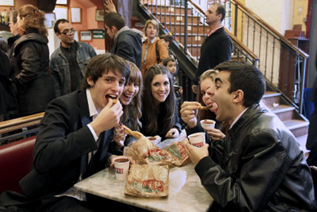
In New Year’s Eve, apart from closing the year eating our lucky 12 grapes, after a long night of partying, we start the new year eating churros with chocolate (the good ones, not the ones that are apparently sold in Poland and other neighbouring countries which are sometimes even wrongfully labelled as Mexican). I think this intimate yet completely public moment really capture what it’s like to live Christmas in the city, an ocean of nameless faces united by their shared love for life (and for churros), starting this new year together and creating a broader special occasion. Some anthropologists believe that humanity, as a society, started once we started having more food and could therefore sit calmly and enjoy meals together, as a group.
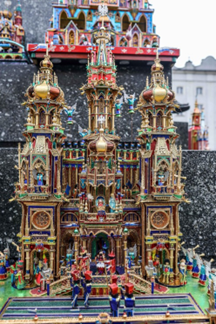
Traditions like the morning churros in the 1st of January still remain and survive the postmodern current that seem to erase specific essences in cities and rather prefer a general ambiguous idea of what a European city should look or feel like. For example, the Szopka from Krakow, a beautiful tradition that reinvents the typical nativity scene with a sprinkle of the city’s characteristic architecture, wouldn’t have probably be known to many foreigners, such as me and my family, if it weren’t for planes and open borders that allowed us to discover other cultures during the holidays. It seems like no matter how cosmopolitan or international a city is, an essence still remains almost untouched. If loneliness is always present at the heart of every city, so is a big community that welcomes with open arms anyone willing to participate, enjoy and learn about how Christmas looks, sounds and even tastes like in other cultures.
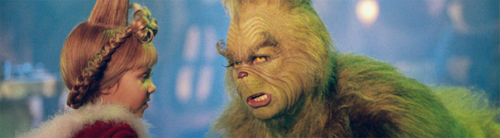
During the month of December, I proposed a debate on the upsides and downsides of Christmas with the students of . XXVII Liceum im. dr Henryka Jordana. Though sometimes the Grinchs of the class seemed to make compelling arguments, it was interesting to see how the first positive aspect of Christmas, as discussed by the students, was spending time with the family. Rousseau, pessimistic and antisocial thinker blindly held as a humanist, poses the question; ‘‘Why should we build our happiness on the opinions of others, when we can find it in our own hearts?’’
Happiness, like many things, is better shared. Smiles are as contagious as the holiday cheer. Christmas, in essence and wherever you celebrate it, is about people. Not even family, it can be your own found family in a scary and cold city, the warmest place during Christmas time is never a place but a person. They say home is where the heart is but it’s a who. Be it friends, family or friendly strangers, like the Christmas defenders during the debate said, it’s not about the gifts. It’s about the meaning of the gift, not the object itself, from who to who and why, the feeling behind it, not the what. For me, this Christmas was special not only since I could share Krakow with my family or go back home to my loved ones, the experience in the classrooms was also special. Creating Nativity scenes during Spanish classes, sharing traumatic stories about the carp in the bathtubs or reminding the students time and time again the names of the Three Wise Men (Melchor, Gaspar and Baltasar), Christmas is about sharing – not material things, but also stories, cultures, experiences and feelings.
Sara Rodríguez